Vanguard Restoration: First Stage
New Life as a Max Level ArchmageVanguard Restoration: First Stage marks the moment when Vanguard ceases to be merely a sealed relic of the past and begins functioning again as an organization. Its decisive movement is both administrative and symbolic: Vivisari Vexaria authorizes new membership, Rafael completes the restoration procedure, Mae returns after a century of avoidance, and the System recognizes the guild’s renewal by raising it to tier one and reopening important facilities.
Causes and Historical Background
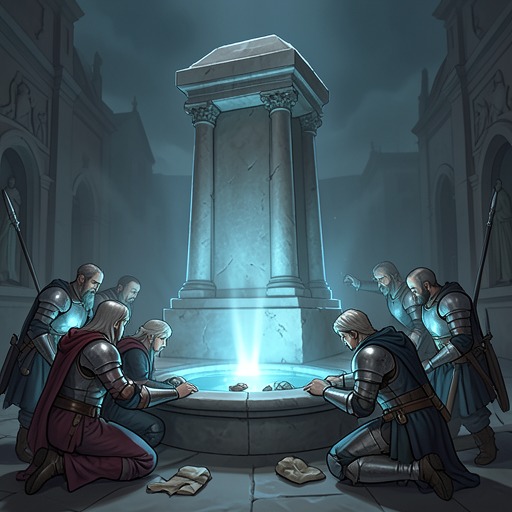
Vanguard had once been associated exclusively with the Party of Heroes, the legendary adventuring group that defeated the seventh and final Cataclysm a hundred years earlier, though all of its members except the Sorceress perished in that victory. The organization therefore carries the weight of a heroic age that has become public history. Prismarche’s Temple displays images of saints, heroes, and Vivisari’s party, while the Peace Day Festival commemorates a century of freedom from the Cataclysms that had ravaged the world. Vanguard’s restoration consequently occurs against a culture that remembers its founders as saviors rather than as ordinary guild members.
That historical distance is also what makes the restoration necessary. The guildhall had remained closed for a century, and Rafael understands that reopening it is not a routine change of ownership but a momentous return. Vivisari’s presence gives the process unusual authority: people who remember the old Vanguard treat her words as carrying the force of a vanished era, even while her return is increasingly difficult to interpret through ordinary heroic categories. The restoration thus answers two conditions at once—the practical dormancy of the guild and the larger political and emotional vacuum left by the Party of Heroes’ disappearance.
Reopening the Guild and Reinducting Mae
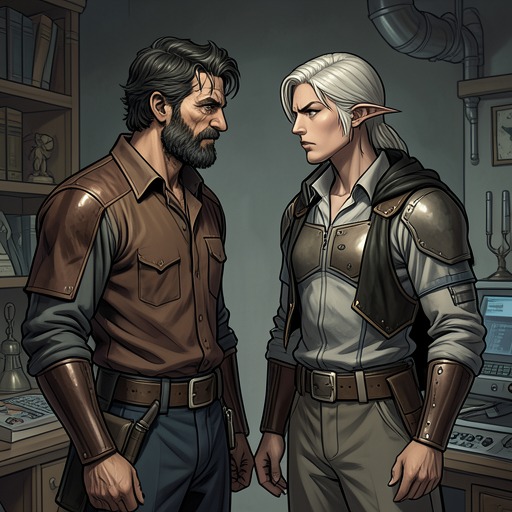
Rafael takes control of the immediate procedure by proposing that the first stage can be completed through Miraelle’s induction, while also seeking confirmation from Mae about whether she truly wishes to rejoin Vanguard. His method is characteristically orderly: he moves to the quest board, retrieves the relevant paper, and asks to take the group to his office so the institutional requirement can be fulfilled rather than allowing the reunion to dissolve into sentiment or bickering.
Mae’s answer reveals how long her exclusion from Vanguard has shaped her life. She says that she has avoided every other guild for the past hundred years for a reason, then hesitates over whether she is still welcome. Vivisari assures her that her welcome requires no further qualification. Mae’s beaming smile, immediately restrained out of embarrassment, shows that the restoration is not only a mechanical quest objective. For someone who has preserved her distance from other guilds, recognition by the returned founder restores a lost place in the social world as well as a professional affiliation.
Before this moment, only the Party of Heroes had been adventuring members of Vanguard. Vivisari’s decision to open recruitment breaks that century-old boundary. Mae, formerly a craftsman and now an adventurer, is positioned as the first new member under the broadened policy. Her admission therefore changes Vanguard’s identity from a closed memorial to a living guild capable of gathering people outside its original heroic circle.
The Systemic Completion of the First Stage
The formal restoration requires signatures. After Rafael confirms that Mae wants to return, he completes the form and gives the clipboard to her. Mae hesitates, then signs. Vivisari must also sign, and her hesitation has a different source: she has never signed a document as Vivisari Vexaria and wonders whether the anti-forgery enchantment will recognize her handwriting as belonging to the Sorceress. The question exposes the peculiar tension of her return. She possesses the founder’s identity, but she is still testing how completely the world’s institutions, enchantments, and System accept that identity.
The System validates her signature. The quest paper on Rafael’s desk immediately ignites in golden fire, filling the room with heat and brilliant light before disappearing without ashes or scorch marks. The transformation is precise and impersonal: a bureaucratic condition becomes a supernatural confirmation. Rafael reads the result as completion and checks the guild charter, finding that Vanguard is now a tier-one guild.
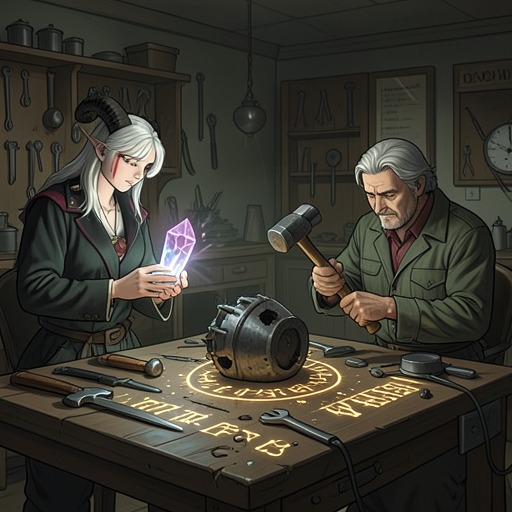
The tier advancement carries concrete consequences. The craftsmen’s quarters should be accessible, and at least a portion of the vault should have reopened. Mae reacts most strongly to the restoration of her laboratory, rushing away before anyone can continue the conversation. Jasper contrasts her choice with the alternative of an unbound artifact of level two thousand from a dead Cataclysm, but Mae’s priority makes the restoration’s human dimension clear: a recovered workplace and creative identity matter more to her than the most spectacular available treasure.
Architecture, Memory, and Institutional Meaning
Vanguard’s guildhall is larger inside than outside, a feature explained by the System’s translation of the game’s guild mechanics into reality. Inactive or poor guilds had once relied on instanced versions, while wealthy guilds received permanent real estate and risked eviction through inactivity. Upgrading a guild tier expanded its interior without requiring a larger exterior building or plot. Vanguard’s reopened space therefore embodies the organization’s status in physical form: the same modest-looking structure contains a renewed, enlarged institutional world.
The restoration also links material infrastructure to membership and authority. A signature, a quest document, a guild charter, and the System’s recognition cooperate to reopen rooms that had been inaccessible for a century. The guild is not restored by nostalgia alone. Its renewal depends on an active network of people, rules, enchantments, facilities, and magical administration, with Rafael providing procedural continuity, Vivisari providing founder legitimacy, and Mae supplying the first decisive act of new participation.
The event’s significance is sharpened by the wider atmosphere of post-Cataclysm peace. Prismarche celebrates one hundred years without the old disasters, yet Master Aeris warns that an Eighth Cataclysm is always possible, and Vivisari’s later display of overwhelming power makes witnesses imagine that a god has descended rather than that the Sorceress has simply returned. Against that background, Vanguard’s restoration is a smaller-scale answer to the same anxiety: the world cannot rely solely on commemorating the heroes who ended the last age of destruction. It must rebuild structures capable of acting when the next crisis arrives.
Consequences and Narrative Significance
The completed first stage gives Vanguard a new direction. It remains anchored in the Party of Heroes and in the memory of the Sorceress, but it is no longer restricted to those original adventurers. Mae’s reinduction establishes recruitment as an intentional policy, while the tier-one upgrade restores the physical and productive capacities needed for future activity. The reopened laboratory is an immediate benefit, but the broader consequence is the return of a functioning guild framework.
The event also changes the meaning of Vivisari’s return. At first, her place survives in temples, festivals, and historical images; through Vanguard, that place becomes operational. She is not merely a figure represented in stained glass or praised for an ancient victory. Her signature is accepted, her authority activates a quest, and her decision changes who may belong to the organization. The restoration therefore joins public memory to present action, turning a legendary past into an institutional future.
Its structure resembles a return phase in heroic narrative, but with an important inversion. Vivisari does not restore the old order by sealing it unchanged. The returning founder opens the ranks, admits someone outside the original heroic party, and allows the System to convert remembrance into expansion. Vanguard Restoration: First Stage is consequently less a resurrection of a dead guild than a controlled redefinition of what Vanguard is allowed to become.